Corporate Finance Advisory
- HOME
- Banking & Finance
- IPO Advisory Services
IPO Advisory Services
An initial public offering (IPO) can be a complex and challenging process, but it is one of the most valuable opportunities for companies to raise capital, improve their reputation and credibility, and allows companies and shareholders alike to gain tax-exempt dividends from investment. It is crucial for a company intending to go public to understand the steps involved in conducting an IPO on the Thai Stock Exchange.
Opening a company to the public market allows it to tap into a vast pool of potential investors and secure the capital it needs to fuel the company’s growth and success.
| Company benefit | Why |
|---|---|
| Sustainable Funding Source |
|
| Tax Privileges on Dividends |
|
| Better Reputation and Credibility |
|
| Business Network |
|
| Employee Morale |
|
| Shareholders’ benefit | Why |
|---|---|
| Enhanced Liquidity | It is easier to trade stocks for cash on the public market. |
| Shareholder Protection | Rules and regulations governing securities trading and information disclosure ensure shareholders’ investments are protected. |
| Tax Benefits | Individual investors selling shares in a company listed on the Thai Stock Exchange are not required to pay tax on the capital gains earned from the sale. |
Main Stock Exchanges
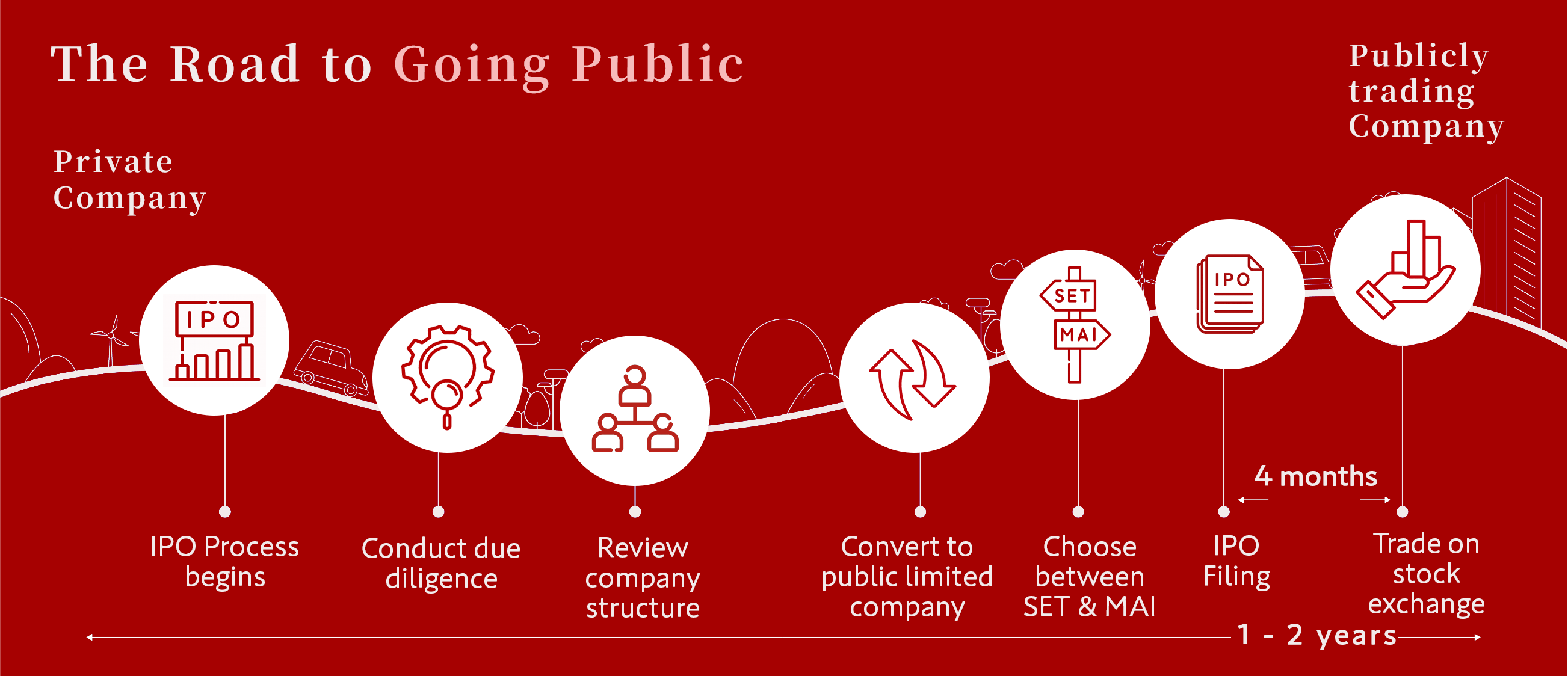
Thailand has two exchanges: the Stock Exchange of Thailand (SET) and the Market for Alternative Investment (MAI). While the application regulations for the SET and MAI are the same, their specific listing requirements are different.Thailand has one of the most liquid markets in Asia, which is crucial for a company considering listing; higher liquidity makes it easier for buyers and sellers to trade. The SET ranks first in the Association of Southeast Asian Nations (ASEAN) for trading liquidity.
The SET
The Stock Exchange of Thailand (SET) is the country’s main stock exchange. It is responsible for processing all listing applications, ensuring that listed companies meet disclosure requirements, and monitoring trading activity. The SET tends to attract large companies as well as a broader range of industries, such as the automotive, technology and digital industries. It offers a range of securities, including shares, warrants, and investment units.For domestic entities, the specific listing requirements differ depending on whether the company is a a) general business; b) basic utilities business; or c) holding company. For foreign entities, the requirements differ depending on whether they are applying for a primary or secondary listing. All entities, regardless of whether domestic or foreign, must list under one of the eight industry groups and twenty-eight sectors.
The MAI
With its less rigorous requirements – such as a lower paid-up capital requirement and a lower number of required shareholders – the market for alternative investment (MAI) tends to attract small and medium-sized companies. It allows start-ups and innovative businesses with high growth potential to access broader fundraising opportunities as it draws in venture capitalists.
How Can We Help?
At ALG &Associates(Thailand)Co.,Ltd., we are a key partner throughout the offering process. Our legal team will advise clients on possible IPO restrictions arising from contract, and assist in ensuring compliance with relevant laws and regulations governing the process. Additionally, our lawyers are generally involved in drafting the registration statement and prospectus. We also assist with financial advisory services, which include:
- Conducting due diligence;
- Establishing standard internal control systems;
- Restructuring the company as needed, including business, equity and shareholdingstructures;
- Preparing documents and information for the IPO filing and listing application; and
- Distributing securities or employing an underwriter to distribute securities.